Species-specific accumulation and bioconcentration patterns of phosphorus and heavy metals in urban tree leaves across contrasting pollution gradients in Dhaka, Bangladesh
Keywords:
Urban trees, Heavy metals, Phosphorus, Bioconcentration factor, Phytoremediation, Environmental pollutionAbstract
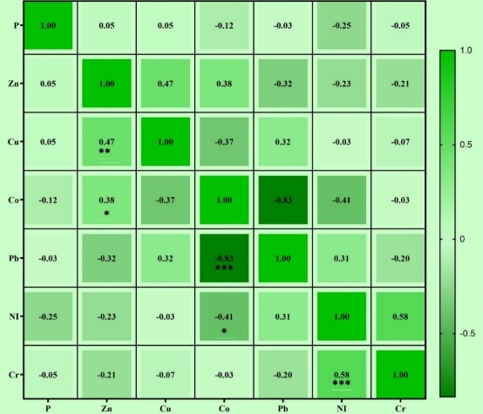
Urban trees play a vital role in mitigating environmental pollution, yet their responses to heavy metal stress across contrasting urban gradients remain poorly understood. This study investigates the accumulation patterns of phosphorus (P) and six heavy metals (Zn, Cu, Co, Pb, Ni, Cr) in leaves and associated soils of nine dominant tree species across control and polluted sites in Dhaka, Bangladesh. Two-way ANOVA revealed significant (p < 0.05) site effects for P, Ni, and Cr, and pronounced species-specific significant (p < 0.001) differences in Zn uptake. Leaf P concentrations generally declined under pollution, while species such as Syzygium cumini and Terminalia catappa showed elevated heavy metal content, indicating varied tolerance mechanisms. Bioconcentration factors (BCFs) highlighted differential metal accumulation capacities, with increased Pb and Ni uptake in select species under polluted conditions. Pearson correlation and PCA analyses revealed complex interactions among elements, with strong antagonistic relationships between Pb and Co/Cr, and a positive association between Pb, Ni, and Cu. PCA further distinguished control and polluted sites based on metal profiles, underscoring pollution-driven shifts in elemental composition. These findings suggest that species-specific uptake behaviors are crucial for urban ecosystem management. The study identifies resilient tree species with phytoremediation potential, offering valuable guidance for sustainable urban greening and pollution mitigation in rapidly urbanizing cities.
Downloads
References
1. Garg VK, Aggarwal A. Spatio-temporal variation in metal contamination in urban soils: A case study. Environ Earth Sci. 2011; 62(7): 1445–1456.
2. Islam MS, Hossain MD, Zakir HM, Moniruzzaman M. Soil pollution in urban Bangladesh: Sources, risks, and sustainable management. Environ Sci Pollut Res. 2021; 28: 10342–10359.
3. Kashem MA, Rahman MA, Hussaini SM, Hossain MZ. Effects of air pollution on the leaf morpho - physiological traits of some common tree species of Ramna Park and its adjacent roadside areas in Dhaka city, Bangladesh. Mol. 2022; 22: 9.
4. Kashem MA, Rahman MA, Hussaini SM, Rashid MM, Hossain MZ. Variation in the macro-morphological traits of leaves in response to automobile pollution in selected urban tree species in the city of Dhaka. J Ecol. 2023; 5(2): 145-153.
5. Nowak DJ, Crane DE, Stevens JC. Air pollution removal by urban trees and shrubs in the United States. Urban For Urban Green. 2006; 4(3-4): 115–123.
6. Kabata-Pendias A. 2011. Trace Elements in Soils and Plants (4th ed.). CRC Press.
7. Ali H, Khan E, Sajad MA. Phytoremediation of heavy metals—Concepts and applications. Chemosphere. 2013; 91(7): 869–881.
8. Dadea C, Russo A, Tagliavini M, Mimmo T, Zerbe S. Tree species as tools for biomonitoring and phytoremediation in urban environments: A review with special regard to heavy metals. Arboric Urban For. 2017; 43(4): 155-167.
9. Barwise Y, Kumar P. Designing vegetation barriers for urban air pollution abatement: A practical review for appropriate plant species selection. npj Clim Atmos Sci. 2020; 3: 12.
10. Manasa C, Salimath SK, Hegde R, Dechamma DN, Gooli M. Roles of trees for abatement of environmental pollution: A review. Int J Biores Stress Manag. 2023; 14(10): 1403-1410.
11. Singh R, Gautam N, Mishra A, Gupta R. Heavy metals and living systems: An overview. Indian J Pharmacol. 2011; 43(3): 246.
12. Ali H, Khan E. Trophic transfer, bioaccumulation, and biomagnification of non-essential hazardous heavy metals and metalloids in food chains/webs—Concepts and implications for wildlife and human health. Hum. Ecol Risk Assess. 2019; 25(6): 1353-1376.
13. Edo GI, Samuel PO, Oloni GO, Ezekiel GO, Ikpekoro VO, Obasohan P, Agbo JJ. Environmental persistence, bioaccumulation, and ecotoxicology of heavy metals. Chem Ecol. 2024; 40(3): 322-349.
14. Sharma P, Dubey RS. Lead toxicity in plants. Braz J Plant Physiol. 2005; 17(1): 35-52.
15. Yadav SK. Heavy metals toxicity in plants: An overview on the role of glutathione and phytochelatins in heavy metal stress tolerance of plants. S Afr J Bot. 2010; 76(2): 167-179.
16. Nagajyoti PC, Lee KD, Sreekanth TVM. Heavy metals, occurrence and toxicity for plants: a review. Environ Chem Lett. 2010; 8(3): 199-216.
17. Rahman SU, Qin A, Zain M, Mushtaq Z, Mehmood F, Riaz L, Shehzad M. Pb uptake, accumulation, and translocation in plants: Plant physiological, biochemical, and molecular response: A review. Heliyon. 2024; 10: 6.
18. Wang Y. Zhang Y, Zhao X. Influence of rhizosphere microorganisms on heavy metal uptake by plants. Chemosphere. 2020; 251: 126452.
19. Khan A, Shahid M, Khan S. Uptake and translocation of phosphorus and heavy metals in wheat: Response to environmental pollution. Environ Pollut. 2021; 276: 116705.
20. Monib AW, Niazi P, Azizi A, Sediqi S, Baseer AQ. Heavy metal contamination in urban soils: health impacts on humans and plants: a review. EJTAS. 2024; 2(1): 546-565.
21. Zandybay A, Saspugayeva G, Khussainov M, Karelkhan N, Kydyrova A, Adylbek Z. Assessing the Impact of Urban Development on Soil Health and Nutrient Cycling Across Urban Areas. J Ecol Eng. 2024; 25(12): 106-123.
22. Ghosh M, Singh SP. A review on phytoremediation of heavy metals and utilization of its byproducts. Appl Ecol Environ Res. 2005; 3(1): 1-18.
23. Hassan S, Bhat SA, Kumar V, Ganai BA, Ameen F. Phytoremediation of heavy metals: an indispensable contrivance in green remediation technology. Plants. 2022; 11(9): 1255.
24. Begum BA, Biswas SK, Hopke PK. Key issues in controlling air pollutants in Dhaka, Bangladesh. Atmos Environ. 2011; 45(40): 7705–7713.
25. Kabir MH, Rashid MH, Wang Q, Wang W, Lu S, Yonemochi S. Determination of heavy metal contamination and pollution indices of roadside dust in Dhaka City, Bangladesh. Processes. 2021; 9(10): 1732.
26. Al-Kaium A, Hosen S, Shamsi S. Frequency, abundance and distribution of lichen in National Botanical Garden, Mirpur, Dhaka, Bangladesh. Dhaka Univ J Biol Sci. 2022; 31(2): 273-280.
27. Jackson ML. Soil Chemical Analysis. Prentice-Hall. NJ (1958).
28. Augustine AU, Onwuka JC, Albert CQ. Determination of heavy metal concentration in Neem (Azadirachta indica) leaves, bark and soil along some major roads in Lafia, Nasarawa State Nigeria. J Environ Chem Ecotoxicol. 2016; 8(5): 38-43.
29. Bailer AJ, Walker SE, Venis KJ. Estimating and testing bioconcentration factors. Environ Toxicol Chem. 2000; 19(9): 2338-2340.
30. Fu W, Franco A, Trapp S. Methods for estimating the bioconcentration factor of ionizable organic chemicals. Environ Toxicol Chem. 2009; 28(7): 1372-1379.
31. Raj D, Kumar A, Maiti SK. Mercury remediation potential of Brassica juncea (L.) Czern. for clean-up of flyash contaminated sites. Chemosphere. 2020; 248: 125857.
32. Thakur S, Singh L, Wahid ZA, Siddiqui MF, Atnaw SM, Din MFM. Plant-driven removal of heavy metals from soil: uptake, translocation, tolerance mechanism, challenges, and future perspectives. Environ Moni. Assess. 2016; 188(4): 206.
33. Emamverdian A, Ding Y. Effects of heavy metals' toxicity on plants and enhancement of plant defense mechanisms of Si-mediation. Int J Environ Agri Res. 2017; 3(4): 41-51.
34. Giri J, Bhosale R, Ganapathi TR, Banerjee M. Engineering plants for heavy metal tolerance and phytoremediation. Plant Cell Rep. 2017; 36(11): 1589–1602.
35. Parlak KU, Yilmaz DD. Response of antioxidant defences to Zn stress in three duckweed species. Ecotoxicol Environ Saf. 2012; 85: 52-58.
36. Al Mahmud J, Bhuyan MB, Anee TI, Nahar K, Fujita M, Hasanuzzaman M. Reactive oxygen species metabolism and antioxidant defense in plants under metal/metalloid stress. In: Plant abiotic stress tolerance: agronomic, molecular and biotechnological approaches. 2019, (pp. 221-257). Cham: Springer International Publishing.
37. Yruela I. Copper in plants: Acquisition, transport and interactions. Funct Plant Biol. 2009; 36(5): 409–430.
38. Schulten A, Krämer U. Interactions between copper homeostasis and metabolism in plants. Prog Bot. 2017; 79: 111-146.
39. Mir AR, Pichtel J, Hayat S. Copper: uptake, toxicity and tolerance in plants and management of Cu-contaminated soil. Biometals. 2021; 34(4): 737-759.
40. Karmakar P, Pradhan S, Chakraborty S. Exploring indoor health: An in-depth field study on the indoor air quality dynamics. arXiv preprint. 2023; 2310: 12241.
41. Perri G, Gargano D, Randazzo L, Calabrese S, Brusca L, Fuoco I, La Russa MF. Nature-Based Options for Improving Urban Environmental Quality: Using Black Poplar Trees for Monitoring Heavy Metals Pollution in Urbanized Contexts. Resources. 2024; 13(6): 85.
42. Nwoko CE, Singer DM, Tessin AC, Izworski R, Heestand C. Spatial variability in the speciation of lead (Pb) and other metals across urban lawns is linked to post-deposition weathering reactions. Soil Systems. 2024; 8(4): 113.
43. Sundaramoorthy P, Chidambaram ALA, and Ganesh, K. S., Chromium stress in paddy: (Oryza sativa L.)—A short review. Plant Arch. 2010; 10(2): 727–730.
44. Soni S, Jha AB, Dubey RS, Sharma P. Alleviation of chromium stress in plants using metal and metal oxide nanoparticles. Environ Sci Pollut Res. 2023; 30(35): 83180-83197.
45. Singh D, Dhal NK. Chromium-Induced Oxidative Stress and Adaptive Response by Plants: A Physicochemical Review. Russ J Plant Physiol. 2023; 70(3): 22.
46. Haseeb M, Iqbal S, Hafeez MB, Saddiq MS, Zahra N, Raza A, Siddiqui MH. Phytoremediation of nickel by quinoa: Morphological and physiological response. Plos One. 2022; 17(1): e0262309.
47. Hassan Z, Aarts MG. Opportunities and feasibilities for biotechnological improvement of Zn, Cd or Ni tolerance and accumulation in plants. Environ Exp Bot. 2011; 72(1): 53-63.
48. Liu Q, Liu J, Liu H, Zhang S. Soil microbial regulation of heavy metal uptake in urban green plants. Sci Total Environ. 2022; 827: 154359.
49. Seshadri B, Bolan NS, Naidu R. Rhizosphere-induced heavy metal (loid) transformation in relation to bioavailability and remediation. J Soil Sci Plant Nutr, 2015; 15(2): 524-548.
50. Aladesanmi OT, Oroboade JG, Osisiogu CP, Osewole AO. Bioaccumulation factor of selected heavy metals in Zea mays. J Health Pollut. 2019; 9(24): 191207.
51. Farooq MA, Detterbeck A, Clemens S, Dietz KJ. Silicon-induced reversibility of cadmium toxicity in rice. J Exp Bot. 2016; 67(12): 3571–3585.
52. Zhao P, Wan Y, Wan Y, Li Q, Xiong Y, Yang Z, Yang W. The dual role of selenium in mitigating cadmium toxicity and inhibiting trace element uptake in rice highlights the critical trade-off for safe agricultural production. J Environ Manag. 2025; 391: 126527.
53. Xu S, Wu A, Liu J, Gao G, Liu K, Su Y, Yang Y. Spatiotemporal distribution, and risk assessment of Cu and Ni pollution in a farmland soil-corn system of arid Oasis City in Northwest China. Soil Sediment Contam. 2025; 1-22.
54. Fusaro L, Lanni F, Varone L, Falasca G, Serranti S, Gasbarrone R, Manes F. Functional traits as indicators of maize (Zea mays L.) strategies to cope with Zn, Pb and Cr heavy metal-induced stress. Chem Biol Technol Agri. 2025; 12(1): 82.
55. Abhishek S, Ghosh A, Singh AA, Pandey B. Identification of metal-tolerant herbaceous species for phytostabilization and ecological restoration of fly ash dumpsites. Physiol Mol Biol Plants. 2025; 1-20.
56. Oraon S, Gupta P, Mukherjee JR. How do urban trees vary across India? A comparative Analysis across ten Indian cities. Curr Sci. 2025; 129(2): 158-168.
57. Grilo F, McPhearson T, Santos-Reis M, Branquinho C. A trait-based conceptual framework to examine urban biodiversity, socio-ecological filters, and ecosystem services linkages. npj Urban Sustain. 2022; 2(1): 32.
58. Zhang L, Liu X, Zhao J. Functional trait-based approaches to urban forest resilience under pollution stress. Urban For Urban Green. 2023; 85: 127991.
Downloads
Published
Issue
Section
License
Copyright (c) 2025 Authors

This work is licensed under a Creative Commons Attribution-NonCommercial 4.0 International License.