Obesity beyond individual choice: food environments, geolocation technologies, and public policies for obesity prevention
Keywords:
Food environment, Geolocation technologies, Geographic Information Systems, Obesity, Public policy, Territorial inequalitiesAbstract
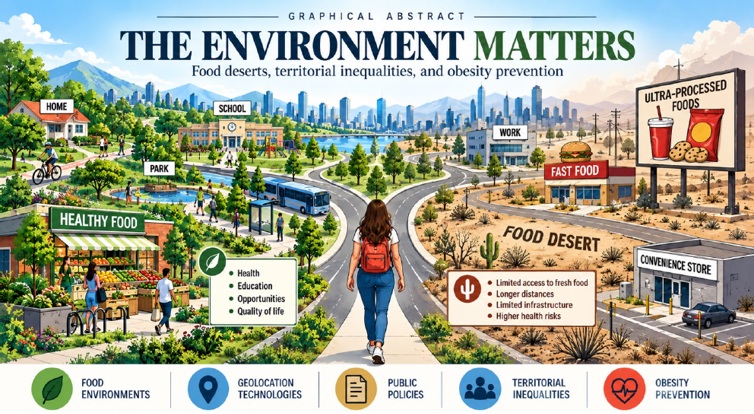
Obesity is a major public-health challenge shaped not only by individual behavior but also by the environments in which people obtain, purchase, prepare, and consume food. Latin America and the Caribbean face a particularly severe burden, marked by high obesity prevalence, food insecurity, and limited affordability of healthy diets. This narrative review examines how food environments, geolocation technologies, territorial inequalities, and public policies influence obesity prevention, weight management, and health promotion in adults. The reviewed evidence indicates that food choices and weight-related outcomes are influenced by the availability, affordability, and type of foods offered within home, retail, institutional, workplace, and mobility-related environments. Geolocation technologies expand this assessment by identifying exposure around residences, workplaces, and commuting routes and by revealing food deserts, food swamps, and territorial inequalities that residential measures alone may overlook. Geographic Information Systems can also support public-health planning, service allocation, and the identification of vulnerable populations, although individual GPS tracking is not a standard WHO method for obesity surveillance. Brazil has a strong normative framework for food and nutrition policy, but implementation varies across institutions and regions. Other Latin American countries have advanced through coordinated regulatory and fiscal measures, while the WHO European Region has placed greater emphasis on regional surveillance, physical-activity policy, product reformulation, and integration with health services. Effective obesity prevention requires coordinated action across food systems, health systems, social policy, and urban planning. Priority actions include improving access to nutritious foods, strengthening healthier community and institutional food environments, protecting children, expanding equitable obesity care, and using geospatial surveillance to identify populations and territories facing the greatest barriers. These findings reinforce that obesity cannot be attributed solely to individual choice and requires structural, territorially informed, and context-specific responses.
Downloads
References
BORGES, C. A.; GABE, K. T.; CANELLA, D. S.; JAIME, P. C. Caracterização das barreiras e facilitadores para alimentação adequada e saudável no ambiente alimentar do consumidor. Cadernos de Saúde Pública, Rio de Janeiro, v. 37, n. 2, e00157020, 2021. Disponível em: https://doi.org/10.1590/0102-311X00157020. Acesso em: 17 mar. 2025.
BRASIL. Ministério da Saúde. Ambiente Obesogênico. Brasília, DF: Glossário Saúde Brasil, 4 nov. 2022. Disponível em: https://www.gov.br/saude/pt-br/assuntos/saude-brasil/glossario/ambiente-obesogenico. Acesso em: 18 mar. 2025.
BURGOINE, T.; FOROUHI, N. G.; GRIFFIN, S. J.; WAREHAM, N. J.; MONSIVAIS, P. Associations between exposure to takeaway food outlets, takeaway food consumption, and body weight in Cambridgeshire, UK: population-based, cross-sectional study. BMJ, London, v. 348, g1464, 2014. Disponível em: https://doi.org/10.1136/bmj.g1464. Acesso em: 5 ago. 2026.
BURGOINE, T.; MONSIVAIS, P. Characterising food environment exposure at home, at work, and along commuting journeys using data on adults in the UK. International Journal of Behavioral Nutrition and Physical Activity, London, v. 10, art. 85, 2013. Disponível em: https://doi.org/10.1186/1479-5868-10-85. Acesso em: 5 ago. 2026.
CASPI, C. E.; SORENSEN, G.; SUBRAMANIAN, S. V.; KAWACHI, I. The local food environment and diet: a systematic review. Health & Place, Oxford, v. 18, n. 5, p. 1172-1187, 2012. Disponível em: https://doi.org/10.1016/j.healthplace.2012.05.006. Acesso em: 5 ago. 2026.
CLYNES, S.; MORAN, A.; WOLFSON, J.; GUDZUNE, K.; SHIELDS, T.; CARDEL, M.; FOSTER, G.; PHELAN, S. A healthier retail food environment around the home is associated with longer duration of weight-loss maintenance among successful weight-loss maintainers. Preventive Medicine, San Diego, v. 172, 107536, 2023. Disponível em: https://doi.org/10.1016/j.ypmed.2023.107536. Acesso em: 17 mar. 2025.
CRANE, N. T.; BUTRYN, M. L.; GORIN, A. A.; LOWE, M. R.; LAFATA, E. M. Overlapping and distinct relationships between hedonic hunger, uncontrolled eating, food craving, and the obesogenic home food environment during and after a 12-month behavioral weight loss program. Appetite, London, v. 185, 106543, 2023. Disponível em: https://doi.org/10.1016/j.appet.2023.106543. Acesso em: 17 mar. 2025.
GORIN, A. A.; RAYNOR, H. A.; NIEMEIER, H. M.; WING, R. R. Home grocery delivery improves the household food environments of behavioral weight loss participants: results of an 8-week pilot study. International Journal of Behavioral Nutrition and Physical Activity, London, v. 4, n. 1, p. 58, 2007. Disponível em: https://doi.org/10.1186/1479-5868-4-58. Acesso em: 17 mar. 2025.
GRILO, M. F.; MENEZES, C.; DURAN, A. C. Food swamps in Campinas, Brazil. Ciência & Saúde Coletiva, Rio de Janeiro, v. 27, n. 7, p. 2717-2728, 2022. Disponível em: https://doi.org/10.1590/1413-81232022277.17772021. Acesso em: 5 ago. 2026.
KONSOR, M.; SCHNEIDER, K. L.; APPELHANS, B. M. Associations between weight loss attempts, food planning, and the home food environment. Journal of Nutrition Education and Behavior, New York, v. 53, n. 1, p. 36-42, 2021. Disponível em: https://doi.org/10.1016/j.jneb.2020.09.001. Acesso em: 17 mar. 2025.
LIU, B.; WIDENER, M. J.; HAMMOND, D.; DUBIN, J. A. Association between time-weighted activity space-based exposures to fast food outlets and fast food consumption among young adults in urban Canada. International Journal of Behavioral Nutrition and Physical Activity, London, v. 17, art. 62, 2020. Disponível em: https://doi.org/10.1186/s12966-020-00967-y. Acesso em: 5 ago. 2026.
LOPES, A. C. S.; MENEZES, M. C.; ARAÚJO, M. L. O ambiente alimentar e o acesso a frutas e hortaliças: uma metrópole em perspectiva. Saúde e Sociedade, São Paulo, v. 26, n. 3, p. 764-773, 2017. Disponível em: https://doi.org/10.1590/S0104-12902017168867. Acesso em: 5 ago. 2026.
LOWE, M. R.; BUTRYN, M. L.; ZHANG, F. Evaluation of meal replacements and a home food environment intervention for long-term weight loss: a randomized controlled trial. The American Journal of Clinical Nutrition, Bethesda, v. 107, n. 1, p. 12-19, 2018. Disponível em: https://doi.org/10.1093/ajcn/nqx005. Acesso em: 17 mar. 2025.
NEVE, K. L.; ISAACS, A. How does the food environment influence people engaged in weight management? A systematic review and thematic synthesis of the qualitative literature. Obesity Reviews, Oxford, v. 23, n. 3, e13398, 2022. Disponível em: https://doi.org/10.1111/obr.13398. Acesso em: 17 mar. 2025.
GERMANI, A. R. M.; IMMIG, J. Análise de planos municipais de saúde e a efetivação da Política Nacional de Alimentação e Nutrição: PNAN em municípios da 6a Coordenadoria Regional de Saúde do Rio Grande do Sul. Segurança Alimentar e Nutricional, Campinas, v. 31, e024034, 2024. Disponível em: https://doi.org/10.20396/SAN.V31I00.8677180. Acesso em: 17 mar. 2025.
TAMURA, K.; ELBEL, B.; ATHENS, J. K.; RUMMO, P. E.; REGAN, S. D.; AL-AJLOUNI, Y. A.; CHAIX, B.; DUNCAN, D. T. Assessments of residential and global positioning system activity space for food environments, body mass index and blood pressure among low-income housing residents in New York City. Geospatial Health, Pavia, v. 13, n. 2, art. 712, 2018. Disponível em: https://doi.org/10.4081/gh.2018.712. Acesso em: 5 ago. 2026.
TEWAHADE, S.; BERRIGAN, D.; SLOTMAN, B.; STINCHCOMB, D. G.; SAYER, R. D.; CATENACCI, V. A.; OSTENDORF, D. M. Impact of the built, social, and food environment on long-term weight loss within a behavioral weight loss intervention. Obesity Science & Practice, Hoboken, v. 9, n. 3, p. 261-273, 2023. Disponível em: https://doi.org/10.1002/osp4.645. Acesso em: 17 mar. 2025.
WIDENER, M. J.; MINAKER, L. M.; REID, J. L.; PATTERSON, Z.; AHMADI, T. K.; HAMMOND, D. Activity space-based measures of the food environment and their relationships to food purchasing behaviours for young urban adults in Canada. Public Health Nutrition, Cambridge, v. 21, n. 11, p. 2103-2116, 2018. Disponível em: https://doi.org/10.1017/S1368980018000435. Acesso em: 5 ago. 2026.
CHAIX, B.; MÉLINE, J.; DUNCAN, S.; MERRIEN, C.; KARUSISI, N.; PERCHOUX, C.; LEAL, C.; BRIANÇON, S.; KESTENS, Y. GPS tracking in neighborhood and health studies: a step forward for environmental exposure assessment, a step backward for causal inference? Health & Place, Oxford, v. 21, p. 46-51, 2013. Disponível em: https://doi.org/10.1016/j.healthplace.2013.01.003. Acesso em: 5 ago. 2026.
SIDDIQUI, N. Z.; WEI, L.; MACKENBACH, J. D.; PINHO, M. G. M.; HELBICH, M.; SCHOONMADE, L. J.; BEULENS, J. W. J. Global positioning system-based food environment exposures, diet-related, and cardiometabolic health outcomes: a systematic review and research agenda. International Journal of Health Geographics, London, v. 23, art. 3, 2024. Disponível em: https://doi.org/10.1186/s12942-024-00362-x. Acesso em: 5 ago. 2026.
WORLD HEALTH ORGANIZATION. Obesity and overweight. Geneva: WHO, 8 Dec. 2025. Disponível em: https://www.who.int/news-room/fact-sheets/detail/obesity-and-overweight. Acesso em: 5 ago. 2026.
YOON, N. H.; YOO, S.; KIM, H.; HAN, Y. Influence of highly accessible urban food environment on weight management: a qualitative study in Seoul. International Journal of Environmental Research and Public Health, Basel, v. 15, n. 4, art. 755, 2018. Disponível em: https://doi.org/10.3390/ijerph15040755. Acesso em: 5 ago. 2026.
FOOD AND AGRICULTURE ORGANIZATION OF THE UNITED NATIONS; WORLD HEALTH ORGANIZATION. Sustainable healthy diets: guiding principles. Rome: FAO; WHO, 2019. Available at: https://www.who.int/publications/i/item/9789241516648. Accessed on: 5 Aug. 2026.
UNITED NATIONS. Transforming our world: the 2030 Agenda for Sustainable Development. New York: United Nations, 2015. Available at: https://sdgs.un.org/2030agenda. Accessed on: 5 Aug. 2026.
FOOD AND AGRICULTURE ORGANIZATION OF THE UNITED NATIONS. Evidence platform for agri-food systems and nutrition: policy recommendations for healthy diets through sustainable food systems. Rome: FAO, 2023. Available at: https://www.fao.org/evidence-platform-agri-food-systems-nutrition/en. Accessed on: 5 Aug. 2026.
HAWKES, C.; SMITH, T. G.; JEWELL, J.; WARDLE, J.; HAMMOND, R. A.; FRIEL, S.; THOW, A. M.; KAIN, J. Smart food policies for obesity prevention. The Lancet, London, v. 385, n. 9985, p. 2410-2421, 2015. Available at: https://doi.org/10.1016/S0140-6736(14)61745-1. Accessed on: 5 Aug. 2026.
WORLD HEALTH ORGANIZATION. Policies to protect children from the harmful impact of food marketing: WHO guideline. Geneva: WHO, 2023. Available at: https://www.who.int/publications/i/item/9789240075412. Accessed on: 5 Aug. 2026.
WORLD HEALTH ORGANIZATION. Fiscal policies to promote healthy diets: WHO guideline. Geneva: WHO, 2024. Available at: https://www.who.int/publications/i/item/9789240091016. Accessed on: 5 Aug. 2026.
AGÊNCIA NACIONAL DE VIGILÂNCIA SANITÁRIA. Rotulagem nutricional. Brasília, DF: Anvisa, 2020. Disponível em: https://www.gov.br/anvisa/pt-br/assuntos/alimentos/rotulagem/rotulagem-nutricional. Acesso em: 5 ago. 2026.
MARIATH, A. B.; MARTINS, A. P. B. Ultra-processed food industry regulation for tackling obesity and diet-related non-communicable diseases in the Brazilian legislature: many proposals, no enactments. Public Health Nutrition, Cambridge, v. 24, n. 10, p. 3110-3118, 2021. Disponível em: https://doi.org/10.1017/S1368980020002530. Acesso em: 5 ago. 2026.
RECINE, E.; CASTRO JUNIOR, P. C. P.; SUGAI, A.; GENTIL, P. C.; SILVA, A. C. F. et al. The INFORMAS healthy food environment policy index in Brazil: benchmarking, current policies, and determining priorities for the future. Obesity Reviews, Oxford, v. 25, n. 3, e13681, 2024. Disponível em: https://doi.org/10.1111/obr.13681. Acesso em: 5 ago. 2026.
SENDA, M. V. G. et al. Brazilian front-of-package labeling: a product compliance analysis 12 months after implementation of regulations. Nutrients, Basel, v. 16, n. 3, art. 343, 2024. Disponível em: https://doi.org/10.3390/nu16030343. Acesso em: 5 ago. 2026.
COLCHERO, M. A.; RIVERA-DOMMARCO, J.; POPKIN, B. M.; NG, S. W. In Mexico, evidence of sustained consumer response two years after implementing a sugar-sweetened beverage tax. Health Affairs, Bethesda, v. 36, n. 3, p. 564-571, 2017. Disponível em: https://doi.org/10.1377/hlthaff.2016.1231. Acesso em: 5 ago. 2026.
TAILLIE, L. S.; REYES, M.; COLCHERO, M. A.; POPKIN, B. M.; CORVALÁN, C. An evaluation of Chile’s Law of Food Labeling and Advertising on sugar-sweetened beverage purchases from 2015 to 2017: a before-and-after study. PLOS Medicine, San Francisco, v. 17, n. 2, e1003015, 2020. Disponível em: https://doi.org/10.1371/journal.pmed.1003015. Acesso em: 5 ago. 2026.
FOOD AND AGRICULTURE ORGANIZATION OF THE UNITED NATIONS. Regional Overview of Food Security and Nutrition in Latin America and the Caribbean 2025: statistics and trends. Santiago: FAO, 2026. Available at: https://www.fao.org/americas/news/news-detail/erradicacion-del-hambre/en. Accessed on: 5 Aug. 2026.
PAN AMERICAN HEALTH ORGANIZATION. Obesity prevention. Washington, DC: PAHO, 2025. Available at: https://www.paho.org/en/topics/obesity-prevention. Accessed on: 5 Aug. 2026.
WORLD HEALTH ORGANIZATION REGIONAL OFFICE FOR EUROPE. WHO European Regional Obesity Report 2022. Copenhagen: WHO Regional Office for Europe, 2022. Available at: https://www.who.int/europe/publications/i/item/9789289057738. Accessed on: 5 Aug. 2026.
WORLD HEALTH ORGANIZATION REGIONAL OFFICE FOR EUROPE. New WHO report highlights progress and challenges in improving physical activity levels across the European Union. Copenhagen: WHO Regional Office for Europe, 7 Nov. 2024. Available at: https://www.who.int/europe/news/item/07-11-2024-new-who-report-highlights-progress-and-challenges-in-improving-physical-activity-levels-across-the-european-union. Accessed on: 5 Aug. 2026.
PAN AMERICAN HEALTH ORGANIZATION. Adoption of front-of-package nutrition warnings can help decrease obesity, cardiovascular disease, type 2 diabetes and some cancers in the Americas. Washington, DC: PAHO, 1 Dec. 2022. Available at: https://www.paho.org/en/news/1-12-2022-adoption-front-pack-nutrition-warnings-can-help-decrease-obesity-cardiovascular. Accessed on: 5 Aug. 2026.
WORLD HEALTH ORGANIZATION. Noncommunicable diseases. Geneva: WHO, 25 Sept. 2025a. Available at: https://www.who.int/news-room/fact-sheets/detail/noncommunicable-diseases. Accessed on: 5 Aug. 2026.
WORLD HEALTH ORGANIZATION. Obesity. Geneva: WHO, 2025b. Available at: https://www.who.int/health-topics/obesity. Accessed on: 5 Aug. 2026.
WORLD HEALTH ORGANIZATION. Noncommunicable diseases: childhood overweight and obesity. Geneva: WHO, 7 May 2025c. Available at: https://www.who.int/news-room/questions-and-answers/item/noncommunicable-diseases-childhood-overweight-and-obesity. Accessed on: 5 Aug. 2026.
WORLD HEALTH ORGANIZATION REGIONAL OFFICE FOR EUROPE. Make obesity prevention and management a central pillar of public health, experts urge. Copenhagen: WHO Regional Office for Europe, 1 Apr. 2025. Available at: https://www.who.int/europe/news/item/01-04-2025-make-obesity-prevention-and-management-a-central-pillar-of-public-health-experts-urge. Accessed on: 5 Aug. 2026.
WORLD HEALTH ORGANIZATION. Launch of the WHO GIS Centre for Health. Geneva: WHO, 9 May 2022. Available at: . Accessed on: 5 Aug. 2026.
WORLD HEALTH ORGANIZATION REGIONAL OFFICE FOR EUROPE. Harnessing geospatial data for better health. Copenhagen: WHO Regional Office for Europe, 5 Jan. 2024. Available at: https://www.who.int/europe/activities/harnessing-geospatial-data-for-better-health. Accessed on: 5 Aug. 2026.
WORLD HEALTH ORGANIZATION REGIONAL OFFICE FOR EUROPE. How can cities shape up? Encouraging healthy diets and active lifestyles in urban environments. Copenhagen: WHO Regional Office for Europe, 31 Aug. 2022. Available at: https://www.who.int/europe/news/item/31-08-2022-how-can-cities-shape-up--encouraging-healthy-diets-and-active-lifestyles-in-urban-environments. Accessed on: 5 Aug. 2026.
Downloads
Published
Issue
Section
License
Copyright (c) 2026 Camila Fernanda Cunha Brandão, Lígia Moriguchi Watanabe, Luísa Maria Diani, Marcela Augusta de Souza Pinhel, Ana Vitória Leca, José de Jesús Martínez González, Débora de Oliveira Emos, Arthur de Andrade Borges, Carla Barbosa Nonino, Natália Yumi Noronha (Author)

This work is licensed under a Creative Commons Attribution-NonCommercial 4.0 International License.