Phytochemical screening, antioxidant and antidiabetic activities of Maerua crassifolia (Forsk) leaves, a medicinal plant used in the treatment of diabetes in Niger
Keywords:
Maerua crassifolia, Medicinal plants, Diabetes, Antioxidant, AntidiabeticAbstract
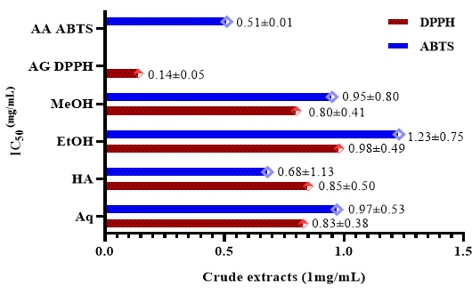
Diabetes is a pathology frequently encountered throughout the world. This disease is currently a public health problem in Africa. Medicinal plants are a source of molecules that can be used as antidiabetic agents. The present study aimed to study the phytochemistry and evaluation of antioxidant and inhibitory activities of α-amylase and α-glucosidase in vitro from crude extracts of aqueous decocted and hydroacetonic, ethanolic and methanolic macerated leaves of Maerua crassifolia. Phytochemical screening was carried out using colorimetric standards methods. The phenolics content was determined used spectrophotometric methods. The antioxidant and antidiabetic activities were evaluated. The screening revealed the presence of several secondary metabolites, such as alkaloids, tannins, flavonoids, coumarins, saponins, sterols and triterpenes. The antioxidant activity results show that the hydroacetonic extract is most active by the ABTS (2,2'-azinobis-(3-ethylbenzothiazoline-6-sulphonic acid)) method with an IC50 (inhibitory concentration 50) equal to 0.68±1.13 mg/mL and 0.80±0.41 mg/mL with the methanolic extract by the DPPH method (2,2-Diphenyl-1-picrylhydrazyl). The evaluation of the enzymatic inhibitory activity of the crude extracts showed inhibition percentages ranging from 61.59% to 90.07% for α-amylase and from 61.42% to 77.66% for α-glucosidase. The presence of certain secondary metabolites (flavonoids, saponosides and tannins) could justify the traditional use of Maerua crassifolia in diabetes management in Niger.
References
1. Macheix JJ, Fleuriet A, Jay-Allemand C. Phenolic compounds in plants: an example of economically important secondary metabolites. Lausanne: PPUR Polytechnic Press; 2005. Available from: https://books.google.ne/books.
2. WHO. WHO cooperation strategy in the country 2009-2015: Niger. Geneva: WHO; 2014. p. 81. Available from: https://iris.who.int/handle/10665/250676.
3. WHO. Global report on diabetes. Geneva: World Health Organization; 2016 [cited 20 July 2022]. 86 p. Available from: https://apps.who.int/iris/handle/10665/254648.
4. Steinmetz JD, Bourne RRA, Briant PS, Flaxman SR, Taylor HRB, Jonas JB, et al. Causes of blindness and vision impairment in 2020 and trends over 30 years, and prevalence of avoidable blindness in relation to VISION 2020: the Right to Sight: an analysis for the Global Burden of Disease Study. Lancet Global Health. 2021; 9(2): e144-160.
5. Habak N, Rouibah N, Chikouche A. Prevalence of hyperuricemia in type 2 diabetics. Algerian J Biochem Med Gen. 2022; 1(2): 18-27.
6. WHO. Guidance on monitoring non-communicable diseases in health facilities: framework, indicators and application. Geneva: WHO; 2022. 68 p. Available from: https://www.who.int/fr/news-room/fact-sheets/detail/diabetes.
7. OOAS. Pharmacopoeia of West Africa. OOAS. 2013. p. 1-268. Available from: https://www.wahooas.org/web-ooas-prod/sites/default/files/publications/2192/manuel-de-formation-des-tradipraticiensok.pdf.
8. WHO. Strategy for Traditional Medicine 2002-2005. Geneva: WHO; 2002. p. 78.
9. Bonga GM, Guede-Guina FR, Vanga-Mandah M. Demonstration of antifungal phytosteroids against Cryptococcus neoformans. Rev Afr Med Pharmacopoeia. 1995; 9: 21-30.
10. Wagner H, Bladt S. Plant Drug Analysis. 2nd ed. Berlin: Springer. 1996. Available from: http://dx.doi.org/10.1007/978-3-642-00574-9.
11. Evans WC, Evans D, Trease GE. Trease and Evans pharmacognosy. 16th ed. Edinburgh; New York: Saunders/Elsevier; 2009. 603 p.
12. Singleton VL, Orthofer R, Lamuela-Raventós RM. Analysis of total phenols and other oxidation substrates and antioxidants using the folin-ciocalteu reagent. In: Methods in enzymology. Vol. 299. Elsevier; 1999. p. 152-78.
13. Arvouet-Grand A, Vennat B, Pourrat A, Legret P. Standardization of propolis extract and identification of the main constituents. Pharm J Belg. 1994; 49(6): 462-468.
14. Bate-Smith EC. Investigation of the chemistry and taxonomy of sub-tribe Quillajeae of the Rosaceae using comparisons of fresh and herbarium material. Phytochemistry. 1965; 4(4): 535‑539.
15. Blois MS. Antioxidant determinations by the use of a stable free radical. Nature. 1958; 181(4617): 1199‑1200.
16. Re R, Pellegrini N, Proteggente A, Pannala A, Yang M, Rice-Evans C. Antioxidant activity applying an improved ABTS radical cation decolorization assay. Free Radical Biol Med. 1999; 26(9‑10): 1231‑1237.
17. Miller GL. Use of the reagent dinitrosalicylic acid for the determination of reducing sugar. Anal Chem. 1959;31(3): 426-428.
18. Nurcholis W, Artika IM, Seno DSH, Andrianto D, Aprianti A, Febrianti F, et al. Phytochemical analysis, in vitro α-glucosidase inhibition activity and kinetic enzyme of ethyl acetate and hexane extracted from Graptophylum pictum (L.) Griff. Current Biochem. 2014; 1(2): 58-65.
19. Diallo AM. Study of medicinal plants from Niafunke (Timbuktu region). Phytochemistry and pharmacology of Maerua crassifolia Forsk (Capparidaceae). Doctoral thesis. University of Bamako. 2005; 140 p.
20. Akuodor GC, Ibrahim JA, Akpan JL, Okorie AU, Ezeokpo BC Phytochemical and anti-diarrhoeal properties of the methanolic leaf extract of Maerua crassifolia Forssk. Eur Rev Med Plants. 2014; 4(10): 1223.
21. Chaib F. Study of some Saharan plants from Tamanrasset «El-Hoggar»: Extraction, Identification and Biological Activities of Essential Oils [Doctoral Thesis]. University of Tlemcen, Algeria; 2018. 165 p.
22. Tachakittirungrod S, Ikegami F, Okonogi S. Antioxidant active principles isolated from Psidium guajava grown in Thailand. Scientia Pharmac. 2007; 75(4): 179‑193.
23. Rubió L, Motilva MJ, Romero MP. Recent advances in biologically active compounds in herbs and spices: a review of the most effective antioxidant and anti-inflammatory active principles. Crit Rev Food Sci Nutr. 2013; 53(9): 943‑953.
24. Fofie NBY, Odoh EA, Kiendrebeogo M, Sanogo R, Kone-Bamba D. Antioxidant and anti-hyperglycemic activity of Sorghum. Sci Nat. 2016; 2: 11.
25. Ckilaka KC, Akuodor GC, Akpan JL, Ogiji ED, Eze CO, Ezeokpo BC. Antibacterial and antioxidant activities of the methanolic leaf extract of Maerua crassifolia. Rev Appl Pharmac Sci. 2015; 5(10): 147-150.
26. Chaib F, Sahki R, Sabaou N, Rached W, Bennaceur M. Phytochemical study and biological activities of certain Saharan plants of the Hoggar. J Agricult Sci. 2015; 7(7): 163.
27. Choho MF, Kporou KE, Ouattara S, Gbogbo M, Kroa E, Kouakou GS, et al. Phytochemical characterization and antioxidant activity of an herbal drug "Datras Epigastro" used in the traditional therapy of gastritis in Côte d'Ivoire. Pharmacopeia Tradit Afr Med. 2022; 21(1): 40-49.
28. Bruneton J. Pharmacognosy, phytochemistry, medicinal plants. 4th ed. Lavoisier; 2009. 1289 p.
29. Bruneton J. Pharmacognosy: phytochemistry medicinal plants. Lavoisier. 1993. p. 316.
30. Bhat M, Zinjarde SS, Bhargava SY, Kumar AR, Joshi BN. Indian antidiabetic plants: a good source of potent amylase inhibitors. Evid-Based Complem Altern Med. 2011; 2011: 10.
31. Perez GRM, Zavala SMA, Perez GS, Perez GC. Antidiabetic effect of compounds isolated from plants. Phytomedicine. 1998; 5(1): 55-75.
Downloads
Published
Issue
Section
License
Copyright (c) 2026 Authors

This work is licensed under a Creative Commons Attribution-NonCommercial-NoDerivatives 4.0 International License.