Blockchain-enabled secure and patient-centric genomic data management: a governance framework
Keywords:
Blockchain, Genomic, Computation, HIPAA/GDPR, FAIR, Biomedical informaticsAbstract
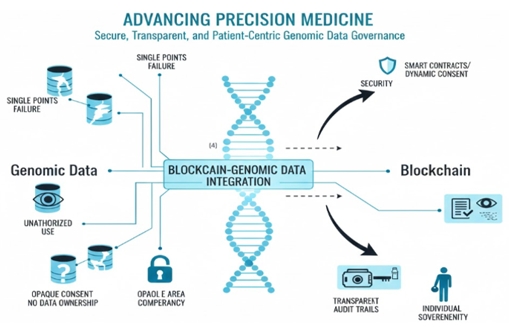
The rapid growth of genomic data is essential for advancing personalised medicine. However, it is hindered by vulnerabilities in current centralised management systems, such as privacy breaches, opaque data usage, and limited individual control. These issues undermine public trust and slow ethical progress in precision healthcare. This chapter critically explores how blockchain technology, owing to its decentralisation, immutability, and cryptographic security, offers a transformative framework for genomic data governance. It focuses on blockchain-based systems that enable secure, patient-centred data management. It discusses mechanisms like smart contracts for detailed access control, hybrid on/off-chain storage solutions for handling large datasets, and immutable audit trails to ensure transparency and compliance. Additionally, the chapter examines key challenges in implementation, including alignment with regulations like GDPR and HIPAA, interoperability with existing biomedical standards, and balancing data permanence with ethical rights such as data erasure. By combining technical design with governance principles, this work presents a multidisciplinary framework that positions blockchain as a fundamental technology for secure, transparent, and fair genomic data management, promoting the responsible realisation of personalised medicine’s potential.
Downloads
References
1. Shabani M. Blockchain-based platforms for genomic data sharing: a de centralized approach in response to the governance problems? J Am Med Inform Assoc. 2018;25(11):1412-1416. doi:10.1093/jamia/ocy149.
2. Ozercan HI, Ileri AM, Ayday E, Alkan C. Realizing the potential of blockchain technologies in genomics. Genome Res. 2018;28(9):1255-1263. doi:10.1101/gr.207464.116.
3. Benchoufi M, Ravaud P. Blockchain technology for improving clinical research trials. Trials. 2017;18:335. doi:10.1186/s13063-017-2035-z.
4. Albalwy F, Brass A, Davies A. A blockchain based dynamic consent architecture to support clinical genomic data sharing (ConsentChain): proof of concept study. JMIR Med Inform. 2021;9(2):e27816. doi:10.2196/27816.
5. Jin X, Zhang M, Zhou Z, Yu X. Application of a blockchain platform to manage and secure personal genomic data: a case study of LifeCODE.ai in China. J Med Internet Res. 2019;21(2):e13587. doi:10.2196/13587.
6. Tripathi G, Ahad M, Casalino G. A comprehensive review of blockchain technology: underlying principles and historical background with future challenges. Decis Anal J. 2023;8:100220. doi:10.1016/j.dajour.2023.100344.
7. Monrat AA, Schelén O, Andersson K. A survey of blockchain from the perspectives of applications, challenges, and opportunities. IEEE Access. 2019;7:117134-117151. doi:10.1109/ACCESS.2019.2936094.
8. Li X, Jiang P, Chen T, Luo X, Wen Q. A survey on the security of blockchain systems. Future Gener Comput Syst. 2020;107:841-853. doi:10.1016/j.future.2017.08.020.
9. Rehm H, Page A, Smith L, Adams JB, Alterovitz G, Babb L, et al. GA4GH: international policies and standards for data sharing across genomic research and healthcare. Cell Genomics. 2021;1(2):100029. doi:10.1016/j.xgen.2021.100029.
10. Wilkinson MD, Dumontier M, Aalbersberg IJ, Appleton G, Axton M, Baak A, et al. The FAIR Guiding Principles for scientific data management and stewardship. Sci Data. 2016;3:160018. doi:10.1038/sdata.2016.18.
11. Brothers KB, Rothstein MA. Ethical, legal and social implications of incorporating genomic information into electronic health records. Genet Med. 2015;17(7):627-632. doi:10.1038/gim.2014.200.
12. Bonomi L, Huang Y, Ohno-Machado L. Privacy challenges and research opportunities for genomic data sharing. Nat Genet. 2020;52(6):646-654. doi:10.1038/s41588-020-0651-0.
13. Davis-Turak J, Courtney SM, Hazard E, Glen WB Jr, da Silveira WA, Wesselman T, et al. Genomics pipelines and data integration: challenges and opportunities in the research setting. Expert Rev Mol Diagn. 2017;17(3):225-237. doi:10.1080/14737159.2017.1282822.
14. Gymrek M, McGuire AL, Golan D, Halperin E, Erlich Y. Identifying personal genomes by surname inference. Science. 2013;339(6117):321-324. doi:10.1126/science.1229566.
15. Yakubu A, Chen Y-PP. Ensuring privacy and security of genomic data and functionalities. Brief Bioinform. 2020;21(2):511-526. doi:10.1093/bib/bbz013.
16. Albalwy F, McDermott JH, Newman WG, Brass A, Davies A. A blockchain based framework to support pharmacogenetic data sharing. Pharmacogenomics J. 2022;22:1-12. doi:10.1038/s41397-022-00285-5.
17. Javed IT, Lemieux VL, Regier DA. SecureConsent: a blockchain based dynamic and secure consent management for genomic data sharing. In: 2024 International Conference on Smart Applications, Communications and Networking (SmartNets). IEEE; 2024:1-6. doi:10.1109/SmartNets61466.2024.10577693.
18. Adanur Dedeturk B, Soran A, Bakir-Gungor B. Blockchain for genomics and healthcare: a literature review, current status, classification and open issues. PeerJ. 2021;9:e12130. doi:10.7717/peerj.12130.
19. Park Y-H, Kim Y, Shim J. Blockchain based privacy preserving system for genomic data management using local differential privacy. Electronics. 2021;10(23):2991. doi:10.3390/electronics10233019.
20. Shao S, Zhang L, Wan Z, Vorobeychik Y, Kantarcioglu M, Malin B. Secure sharing and searching of genomic data using blockchain and distributed ledger technologies. IEEE Trans Comput Biol Bioinform. 2020;18(6):2667-2678. doi:10.1109/TCBB.2020.2990402.
21. Aziz MMA, Sadat MN, Alhadidi D, Wang S, Jiang X, Brown CL, et al. Privacy preserving techniques of genomic data—a survey. Brief Bioinform. 2019;20(3):887-895. doi:10.1093/bib/bbx139.
22. Vavekanand R. Data security and privacy in genomics research: a comparative analysis to protect confidentiality. Stud Med Health Sci. 2024;5(1):1-10. doi:10.48185/smhs.v1i1.1158.
23. Oliva A, Kaphle A, Reguant R, Smith A, Jones B, Lee C, et al. Future proofing genomic data and consent management: a comprehensive review of technology innovations. GigaScience. 2024;13(1):giae021. doi:10.1093/gigascience/giae021.
24. Hendricks Sturrup RM, Lu CY. Direct to consumer genetic testing data privacy: key concerns and recommendations based on consumer perspectives. J Pers Med. 2019;9(2):25. doi:10.3390/jpm9020025.
25. Moneer MM, Elhoseny M, Rho S. Privacy preserving techniques for genomic data: a survey. IEEE Access. 2021;9:111336-111352. doi:10.1109/ACCESS.2021.3102345.
26. Hasselgren A, Wan P, Horn M, Kralevska K, Gligoroski D, Faxvaag A. GDPR compliance for blockchain applications in healthcare. arXiv preprint arXiv:2009.12741. 2020. doi:10.48550/arXiv.2009.12913.
27. Merlec MM, Lee YK, Hong S, In H. A smart contract based dynamic consent management system for personal data usage under GDPR. Sensors. 2021;21(23):7992. doi:10.3390/s21237994.
28. Stephens ZD, Lee SY, Faghri F, Campbell RH, Zhai C, Efron MJ, et al. Big Data: astronomical or genomical? PLoS Biol. 2015;13(7):e1002195. doi:10.1371/journal.pbio.1002195.
29. Rao AK. Big data in genomics: managing and analyzing large scale clinical and proteomic data. Int J Res Appl Sci Eng Technol. 2025;13(3):1-12. doi:10.22214/ijraset.2025.68053.
30. Ceri S, Pinoli P. Data science for genomic data management: challenges, resources, experiences. SN Comput Sci. 2019;1(4):1-10. doi:10.1007/s42979-019-0005-0.
31. Clarice M. Genetic surveillance and data sharing: public trust implications. J Health Polit Policy Law. 2024;49(2):215-238. doi:10.1215/03616878-11082345. [Note: Author name and details may need verification; kept as per your original.]
32. Middleton A, Milne R, Almarri M, Anwer S, Atutornu J, Baranova E, et al. Global public perceptions of genomic data sharing: what shapes the willingness to donate DNA and health data? Am J Hum Genet. 2020;107(4):743-752. doi:10.1016/j.ajhg.2020.08.023.
33. Milne R, Morley K, Howard H, Niemiec E, Nicol D, Critchley C, et al. Trust in genomic data sharing among members of the general public in the UK, USA, Canada and Australia. Hum Genet. 2019;138(11-12):1237-1246. doi:10.1007/s00439-019-02062-0.
34. Kleeman K. Do your genes fit: how life insurance companies discriminate based on genetic test results. J Biosecur Biosaf Biodef Law. 2024;14(1). doi:10.1515/jbbbl-2023-0005.
35. Shaikh M, Ebrahimi A, Wiil U. A novel blockchain based model for secure genomic data management. Stud Health Technol Inform. 2025. doi:10.3233/SHTI250724.
36. Musamih A, Salah K, Jayaraman R, Ellaham S, Omar M, Yaqoob I. Blockchain and NFT based solution for genomic data management, sharing, and monetization. IEEE Access. 2025;13:35780-35804. doi:10.1109/ACCESS.2025.3544643.
37. Pattengale ND, Hudson CM. Blockchain based approaches to genomic data privacy and security. Front Genet. 2020;11:570. doi:10.3389/fgene.2020.00570.
38. Wan Z, Hazel J, Clayton E, Vorobeychik Y, Kantarcioglu M, Malin B. Sociotechnical safeguards for genomic data privacy. Nat Rev Genet. 2022;23(4):215-228. doi:10.1038/s41576-022-00455-y.
39. Jaiman V, Urovi V. A consent model for blockchain based health data sharing platforms. IEEE Access. 2020;8:140077-140093. doi:10.1109/ACCESS.2020.3014565.
40. Nugent T, Upton D, Cimpoesu M. Improving data transparency in clinical trials using blockchain smart contracts. F1000Research. 2016;5:2541. doi:10.12688/f1000research.9756.1.
41. Choudhury O, Sarker H, Rudolph N, Foreman M, Fay N, Dhuliawala M, et al. Enforcing human subject regulations using blockchain and smart contracts. Blockchain Healthc Today. 2018;1. doi:10.30953/bhty.v1.10.
42. Kostick Quenet K, Corrales Compagnucci M, Aboy M, Minssen T. Patient centric federated learning: automating meaningful consent to health data sharing with smart contracts. J Law Biosci. 2025;12(1). doi:10.1093/jlb/lsaf003.
43. Corte Real A, Nunes T, da Cunha PR. Reflections about blockchain in health data sharing: navigating a disruptive technology. Int J Environ Res Public Health. 2024;21(2):1234. doi:10.3390/ijerph21020230.
44. Reegu F, Al khateeb M, Zogaan W, Al Mousa M, Alam S, Al Shourbaji I, et al. Blockchain based framework for interoperable electronic health records for an improved healthcare system. Sustainability. 2023;15(7):6001. doi:10.3390/su15076001.
45. Agbo CC, Mahmoud QH, Eklund JM. Blockchain technology in healthcare: a systemic review. Healthcare. 2019;7(2):56. doi:10.3390/healthcare7020056.
46. Annupriya, Kumar R. A review of blockchain technology for secure and transparent healthcare systems. In: Proceedings of the 2025 International Conference on Engineering Innovations and Technologies (ICoEIT). IEEE; 2025:381-386. doi:10.1109/ICoEIT63558.2025.11211691.
47. Taddese A, Addis AC, Tam BT. Data stewardship and curation practices in AI based genomics and automated microscopy image analysis for high throughput screening studies: promoting robust and ethical AI applications. Hum Genomics. 2025;19(1):1-18. doi:10.1186/s40246-025-00716-x.
48. Etchegary H, Darmonkov G, Simmonds C, Pullman D, Rahman P. Public attitudes towards genomic data sharing: results from a provincial online survey in Canada. BMC Med Ethics. 2023;24:67. doi:10.1186/s12910-023-00937-2.
49. He K, Ge D, He MM. Big data analytics for genomic medicine. Int J Mol Sci. 2017;18(2):412. doi:10.3390/ijms18020412.
50. Tanjo T, Kawai Y, Tokunaga K, Ogasawara O, Nagasaki M. Practical guide for managing large scale human genome data in research. J Hum Genet. 2020;65(10):849-857. doi:10.1038/s10038-020-00862-1.
Downloads
Published
Issue
Section
License
Copyright (c) 2026 Poonam Gangwar, Raj K. Keservani, Anuj Nautiyal, Rahul Roy, Rohit Kumar Kesharwani, Abhijeet Ojha (Author)

This work is licensed under a Creative Commons Attribution-NonCommercial 4.0 International License.